
When you hear the term high-volume document generation , think of it as the powerhouse that lets a business automatically create thousands, or even millions, of personalized documents at once. We're talking about everything from bank statements and insurance policies to utility bills and marketing letters.
It's about taking raw business data and transforming it into polished, professional communications on a scale that would be completely impossible to do with mail merge.
Imagine you're a major power company. At the end of every month, you need to send out millions of unique invoices—all overnight. Each one needs the correct customer name, address, specific usage data, and maybe even a personalized message or two.
Trying to create these at scale would be a nightmare. This is exactly the problem that high-volume document generation is built to solve.
Think of it like a sophisticated assembly line for your information.
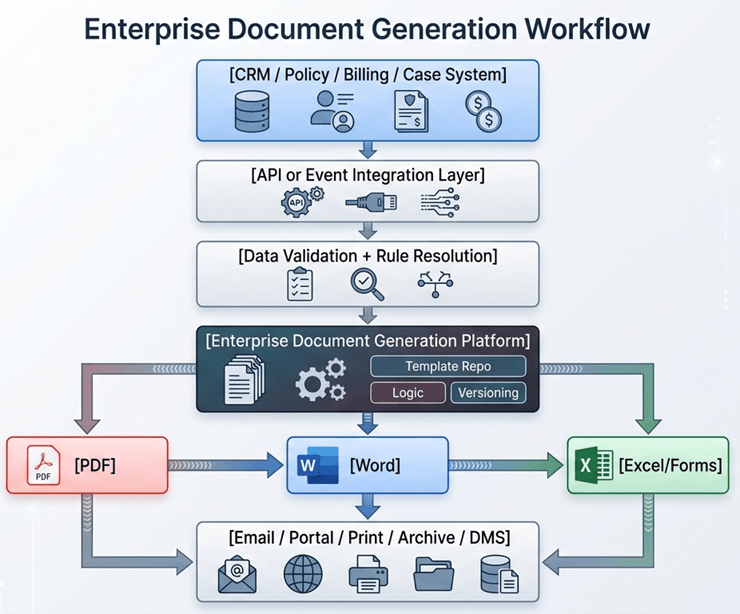
Your raw materials—data from your CRM, ERP systems, and various databases—are fed into one end. They move along a conveyor belt guided by dynamic templates, which are essentially the blueprints that dictate your branding, layout, and overall structure. Document generation software then acts as the master assembler, applying specific rules to customize each document on the fly.
Finally, the finished products—perfectly formatted, accurate documents—roll off the line, ready for delivery through print, email, e-sign, or a customer portal.
For a long time, managing this kind of output was a massive headache for businesses, especially those with fluctuating demand. Electric utility companies, for instance, see a huge spike in document needs at the end of each month when millions of invoices have to go out the door. The same goes for banks sending out monthly statements to all their account holders. You can learn more about these production challenges and see just how critical an efficient system is.
Without a scalable solution, these peaks in demand can lead to costly bottlenecks, errors, and unhappy customers.
The real goal here is to transform a repetitive, resource-draining operational task into a streamlined, automated asset. It's a shift that not only saves a ton of time and money but also boosts accuracy and consistency across every single piece of communication you send.
Before we get into the nitty-gritty, here's a quick overview of how these systems break down.
This table provides a snapshot of the essential components and the kind of results you can expect from a high-volume document generation system.
|
Aspect |
Description |
Primary Benefit |
|
Data Sources |
Raw information pulled from systems like CRMs, ERPs, or databases. |
Uses your existing business data without needing complex transformations. |
|
Dynamic Templates |
Master documents with placeholders for personalized content. |
Ensures brand consistency and professional formatting on every document. |
|
Business Logic |
A set of rules that dictates how data populates the templates. |
Allows for deep personalization and complex, conditional content. |
|
Output Channels |
The delivery methods, such as print, email, web portals, or e-signature. |
Reaches customers through their preferred communication channels. |
|
Generated Output |
The final, personalized documents (e.g., invoices, statements, contracts). |
Delivers accurate, error-free communications at an incredible scale. |
As you can see, each piece of the puzzle plays a specific role in turning a complex process into a simple, automated workflow.
So, what do you actually get out of putting a system like this in place? The advantages are usually immediate and have a real impact on the bottom line.
To really get how millions of documents can be created without a single error, we need to pop the hood on a high-volume document generation system.
At its heart, the system has four key components working together to turn raw data into polished, ready-to-send communications. This isn't just a simple "fill-in-the-blanks" mail merge; it's a dynamic assembly line for your information.
This powerful setup is what lets a single system churn out a massive number of highly personalized documents with incredible speed and accuracy.
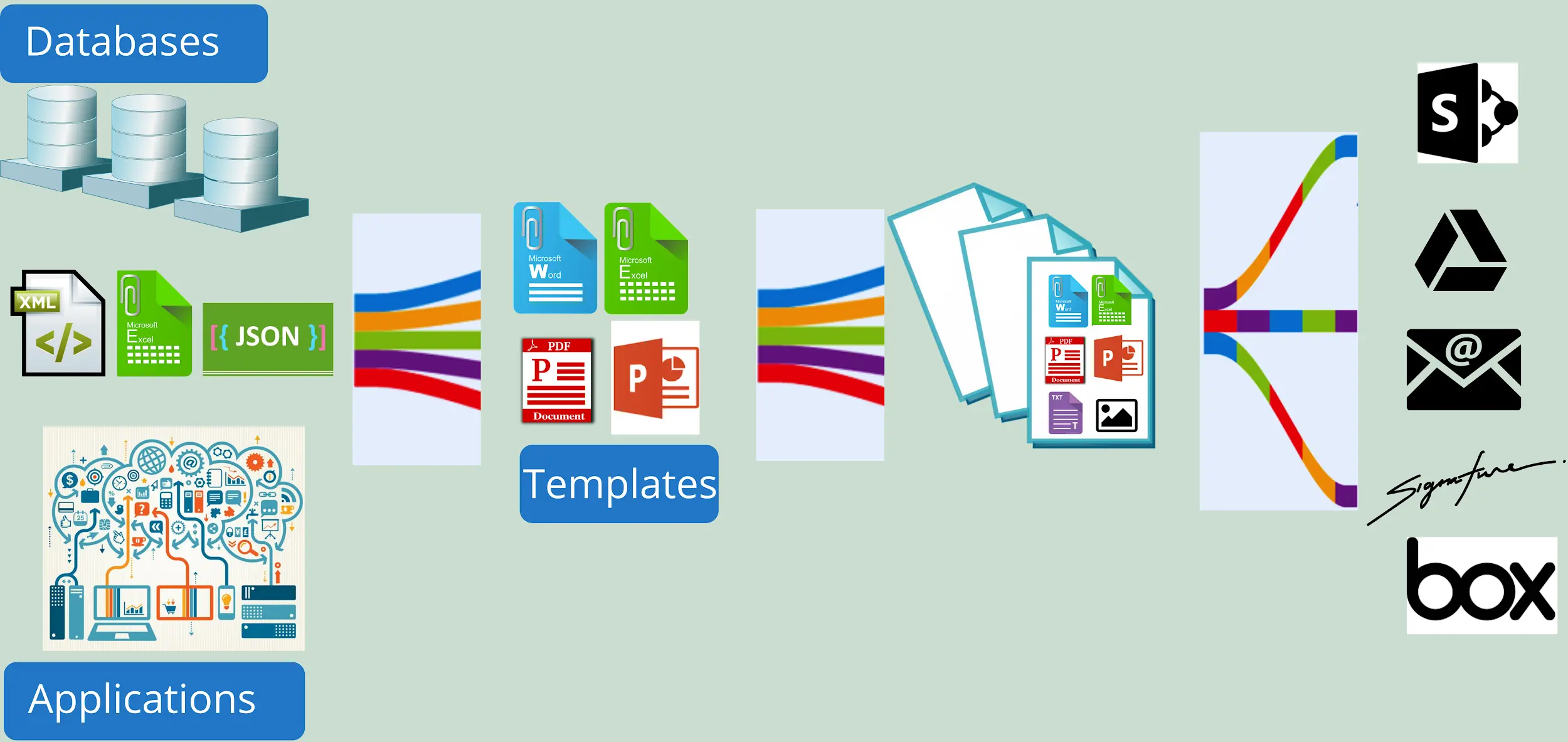
Let's see how this works in the real world. Imagine an insurance company sending out policy renewal letters.
This coordinated process makes sure every single customer gets a timely, accurate, and relevant renewal notice without anyone lifting a finger. It turns what used to be a huge logistical headache into a smooth, automated function that actually makes customer relationships stronger.
Ultimately, the goal of modern document generation software is to tie all these pieces into one seamless, automated workflow. By centralizing your templates and using smart rules, you can ditch the risks and costly errors. To dig deeper into these platforms, have a look at this great overview of what to look for in document generation software .
When you bring a high-volume document generation system into your business, you're not just making documents faster. You’re unlocking real, tangible advantages that echo through every department. The benefits go far beyond speed—they fundamentally change how you operate, communicate, and stay ahead of the competition.
The most immediate impact? A serious drop in operational costs.
Automating the repetitive tasks takes them off your team's plate entirely. This has a huge economic upside. Globally, companies lose up to $1 trillion annually from sloppy document workflows. You can dig into more document processing statistics and trends at SenseTask.com . By switching to an intelligent system, you cut operational overhead and free up your people to work on things that actually move the needle.
In industries like finance, insurance, and healthcare, compliance isn't a "nice-to-have"—it's the law. Trying to stay compliant with manual processes is a constant headache. It means relying on every single employee to perfectly follow complex, ever-changing rules. One slip-up can result in heavy penalties and shatter public trust.
Automated document generation is your best defense against these risks. By using pre-approved, centralized templates, the system ensures every document that goes out the door meets all legal and brand standards.
This brings a few key advantages for compliance:
This structured approach turns compliance from a daily stressor into a built-in, automated safeguard. It protects the business and makes sure every communication is professional and correct.
Here’s where things get really powerful. Automation has a direct impact on your customers. In a crowded market, the quality of your communications can make or break you. Slow, inaccurate, or generic documents just frustrate people and erode trust. But when you deliver timely, accurate, and personalized information, customers feel seen and valued.
High-volume document generation turns a routine operational process into a strategic tool for building customer loyalty. It enables you to deliver the right information, to the right person, at the right time—every time.
Imagine an insurance company that can instantly generate a personalized claims approval letter the moment a decision is made. Or a bank that provides a detailed, easy-to-read investment summary complete with custom charts. These aren't just documents; they're experiences that build confidence and satisfaction.
By delivering highly relevant and professional documents at scale, you're sending a clear message: your organization is reliable, efficient, and genuinely focused on its customers. This positive experience strengthens loyalty and turns routine interactions into a true competitive edge.

The true power of high-volume document generation really comes to life when you see it in action. Whether it’s handling sensitive data in finance or navigating complex regulations in healthcare, automated systems are the engines that keep critical communications flowing accurately and on schedule.
Let's dig into some concrete examples to see how different sectors are using this technology to get ahead of their unique challenges. We’ll look at how finance, insurance, and healthcare are transforming their daily operations.
Financial institutions are built on trust and precision, and their documents have to reflect that. They deal with a staggering amount of paperwork, from daily transaction reports to detailed loan agreements, all containing highly sensitive customer information.
Their biggest challenge? Generating millions of these documents with 100% accuracy while staying compliant with strict regulatory standards.
A perfect example is creating monthly investment portfolio statements. Each statement is a unique, multi-page document that has to pull data from all over the place: market performance figures, individual transaction histories, and client account details. Trying to do this manually would be an operational nightmare just waiting to happen.
By implementing a high-volume system, a bank can:
This not only gets statements out the door faster but also dramatically cuts down the risk of compliance violations and costly data errors.
The insurance industry is another sector practically drowning in documents. From new policy contracts and renewal notices to claims letters and Explanation of Benefits (EOB) forms, every piece of paper is critical.
The main hurdle for insurers is personalization at scale. Every policy is different, and every claim requires specific, tailored correspondence. It’s a massive personalization puzzle.
Think about the claims process. When a claim is approved, denied, or needs more information, the insurer has to send out a detailed letter. This letter needs to be clear, compliant, and customized to that specific claim. A high-volume document generation platform turns this messy task into a smooth, automated workflow.
The system can connect directly to a claims management platform, pull all the relevant details, and generate the right letter in an instant. For a deeper look at this kind of integration, you can explore examples like Dynamics 365 for document generation .
This automation is a game-changer. It means an adjuster can finalize a decision, and a compliant, personalized letter is generated and sent within minutes, not days. That kind of responsiveness is key to improving customer satisfaction during what's often a stressful time for the policyholder.
In healthcare, generating documents is vital for both running the business and taking care of patients. Hospitals and clinics produce a huge volume of paperwork, like patient billing statements, intake forms, and lab results.
The challenge here is twofold: ensuring absolute data privacy under rules like HIPAA and presenting complex medical and billing information in a way that patients can actually understand.
Patient billing is a prime area for automation. A single hospital stay can involve dozens of individual charges from different departments. A document generation system can pull all this information together, apply the right insurance codes, figure out the patient's responsibility, and produce a clear, itemized statement.
This kind of process isn't limited to just billing; it can be applied to many other areas including training.
To make it even clearer, here’s a quick breakdown of how this technology solves specific pain points across these industries.
The following table compares how different industries use high-volume document generation to solve specific operational headaches.
|
Industry |
Primary Document Type |
Key Challenge Solved |
Business Impact |
|
Finance |
Loan Agreements & Portfolios |
Data accuracy and regulatory compliance |
Reduces risk of fines and strengthens client trust. |
|
Insurance |
Policy Documents & Claims Letters |
Personalization at scale for unique policies |
Accelerates claims processing and improves policyholder satisfaction. |
|
Healthcare |
Billing Statements & EOBs |
HIPAA compliance and information clarity |
Simplifies billing and enhances the patient experience. |
Across all these sectors, the theme is consistent. High-volume document generation takes complex, error-prone, and time-consuming manual work and transforms it into a fast, accurate, and strategic automated process.
Bringing in a system for high-volume document generation is a major strategic move. Let's be clear: this isn't just about switching software. It’s about fundamentally rethinking and improving how your business creates and manages its critical communications. A smooth transition all comes down to smart planning, starting with a core decision every company has to make.
The first big question is whether to build a custom solution from the ground up or buy an off-the-shelf platform from a specialized provider. The "build" path gives you complete control and customization, but it comes at a steep price. You'll need significant in-house development resources, not to mention a long-term commitment to maintenance, bug fixes, and support.
On the other hand, the "buy" option gets you a proven, feature-packed platform that's ready to go much faster. For most businesses, buying a solution delivers a quicker return on your investment and lets your IT team focus on what they do best—driving your core business forward—instead of reinventing the wheel.
Once you've decided to buy, it's time to start looking at vendors. But be warned: not all document generation platforms are created equal. You have to look past the slick marketing and dig into the core capabilities that will actually solve your problems, both today and down the road.
Here are the must-have features to put under the microscope:
The right platform should feel like a natural extension of your existing technology stack, not a siloed tool. Its ability to integrate deeply and securely is a direct measure of its long-term value to your organization.
When you start digging into high-volume document generation, a few common questions usually pop up. Let's tackle them head-on to clear up any confusion and help you see the bigger picture.
It’s easy to mix these two up, but they operate on completely different levels. Think of mail merge as the basic tool you’d use for simple tasks, like creating a batch of form letters by pulling names from a spreadsheet. It’s effective, but limited—essentially a digital rubber stamp.
High-volume document generation, on the other hand, is the industrial-strength version. It’s a fully automated, server-based engine built to churn out millions of complex, multi-page documents. It pulls data from all over your business—databases, APIs, you name it—and uses sophisticated logic to build each document perfectly before sending it out through any channel.
To put it simply: mail merge is a bicycle, while high-volume generation is a high-speed freight train.
For any serious business, security isn't just a feature; it's the foundation. Enterprise-grade platforms are built from the ground up to protect sensitive data, especially for industries like finance and healthcare where the rules are incredibly strict.
You should expect to see security woven into every part of the system. This typically includes:
When you're looking at different solutions, treat security as a deal-breaker. A platform's commitment to protecting your data tells you everything you need to know about its reliability and trustworthiness.
Absolutely. We're way beyond just spitting out walls of text. EDocGen can handle all sorts of rich, dynamic content. This means you can automatically drop in charts, graphs, images, barcodes, and complex tables based on your data.
For instance, a bank statement can automatically include a pie chart that visualizes a customer's spending habits, making it much easier to understand at a glance. An insurance policy could feature diagrams and company branding without anyone lifting a finger. This is what turns a standard document into a genuinely helpful and professional communication tool.
Ready to eliminate manual errors and accelerate your document workflows? With EDocGen , you can automate the creation of accurate, professional, and compliant documents at scale. Learn how EDocGen can transform your business communications today .